

> Joseph Taylor > Records > Unto Brigg Fair
Unto Brigg Fair
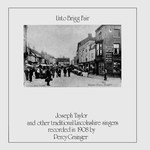 |
Unto Brigg Fair Leader LEA 4050 (LP, mono, UK, 1972) |
Produced by Bob Thomson, Bill Leader and Dave Bland.
Notes by Bob Thomson.
Disc transfers by Bill Leader and A. F. R. Lawrence.
Cylinder transfers by The Library of Congress.
Special filtering and equalisation by Nic Kinsey, Livingston Studios and D. A. Pickett, E. M. I. Studios.
LP master cut by John Wadley, E. M. I. Studios.
Sleeve and booklet designed by Janet Kerr.
Made and printed in England by Brier Press, High Wycombe, Bucks.
Compare to this John Roberts & Tony Barrand’s CD Heartoutbursts: English Folksongs collected by Percy Grainger.
Tracks
All tracks sung by Joseph Taylor (i.e. all of side 1 and tracks 1, 6 and 7 on side 2) unless another singer is noted.
Four digit numbers plus letter denote Gramophone Company matrix numbers; two and three digit numbers are Grainger cylinder numbers.
Side 1
- Sprig o’ Thyme* (Roud 3; G/D 6:1180) (8747e)
- Died for Love* (Roud 60; Laws P25; G/D 6:1170; Henry H683) (8748e)
- Brigg Fair* (Roud 1083) (8748e)
- The White Hare* (Roud 1110; TYG 79) (8750e)
- Lord Bateman* (Roud 40; Child 53L; G/D 5:1023; Henry H470) (8751e)
- Rufford Park Poachers (Roud 1759) (8752e)
- The Gipsy’s Wedding Day (Roud 229; Laws O4) (8752e)
- Worcester City* (Roud 218; Laws P30; G/D 2:210) (8753e)
- Creeping Jane* (Roud 1012; Laws Q23) (8754e)
- Murder of Maria Martin* (Roud 215) (8756e)
- Sprig o’ Thyme* (Roud 3; G/D 6:1180) (8756e)
Side 2
- Bold William Taylor* (Roud 158; Laws N11; G/D 1:169; Henry H213, H757) (2518f)
- Mr Thomson: Lord Bateman (Roud 40; Child 53; G/D 5:1023; Henry H470) (95, 96)
- Joseph Leaning: Green Bushes (Roud 1040; Laws P2; Henry H143) (100)
- Joseph Leaning: The Sheffield Apprentice (Roud 399; Laws O39; G/D 5:998; Henry H31; TYG 71) (100-102)
- George Gouldthorpe: Horkstow Grange (Roud 1760) (84)
- Landlord and Tenant (Roud 1761) (106)
- Bold Nevison (Roud 1082) (110)
- George Wray: Lord Melbourne (Roud 233) (111)
- Dean Robinson: Bold Robin Hood (Roud 1303) (130)
- Dean Robinson: T’owd Yowe Wi’ One Horn (Roud 1762) (131)
*First released 1908
All other titles first released 1972.
Sleeve notes by Bob Thomson
In the early years of the century a few enlightened folk song collectors took the revolutionary step of recording the actual performances of country singers and musicians, thus capturing all the idiosyncrasies of style, where before the words and music had been laboriously and relatively inaccurately transcribed on paper. The cylinder phonograph had made this huge step forward possible.
Bartok’s collecting in eastern Europe is well known. Less well is the pioneer work in England by the Australian composer and pianist, Percy Grainger.
Grainger started recording on location in 1906. He visited various places in England including north Lincolnshire where he recorded several outstanding singers including Joseph Taylor whose singing of Brigg Fair was the inspiration of Delius’ English Rhapsody.
Grainger revisited Lincolnshire in 1908 and in the same year brought Joseph Taylor to the studios of the Gramophone Company to make commercial disc recordings of some of his songs.
It is from these two 1908 ventures that the recordings on this LP are taken. Carefully remastered to eliminate as far as possible the technical short-comings of the period, they are not just old and rare recordings of historic interest, they are amongst the very finest performances of English traditional singing ever to be permanently collected.
The Gramophone Company recordings were made in London on July 9 and 11, 1908.
The cylinders were recorded in Brigg, Lincolnshire.
Numbers 84, 95, 96, 100, 101, 102 on 25 May 1908.
Number 111 on 27 May 1908.
Numbers 130, 131 on 27 May 1908.
Acknowledgements
Thanks to Tony Rees and Abby Sale.